Beginner guide | Updated July 2026
Binary Options for Beginners 2026: Learn Before You Trade
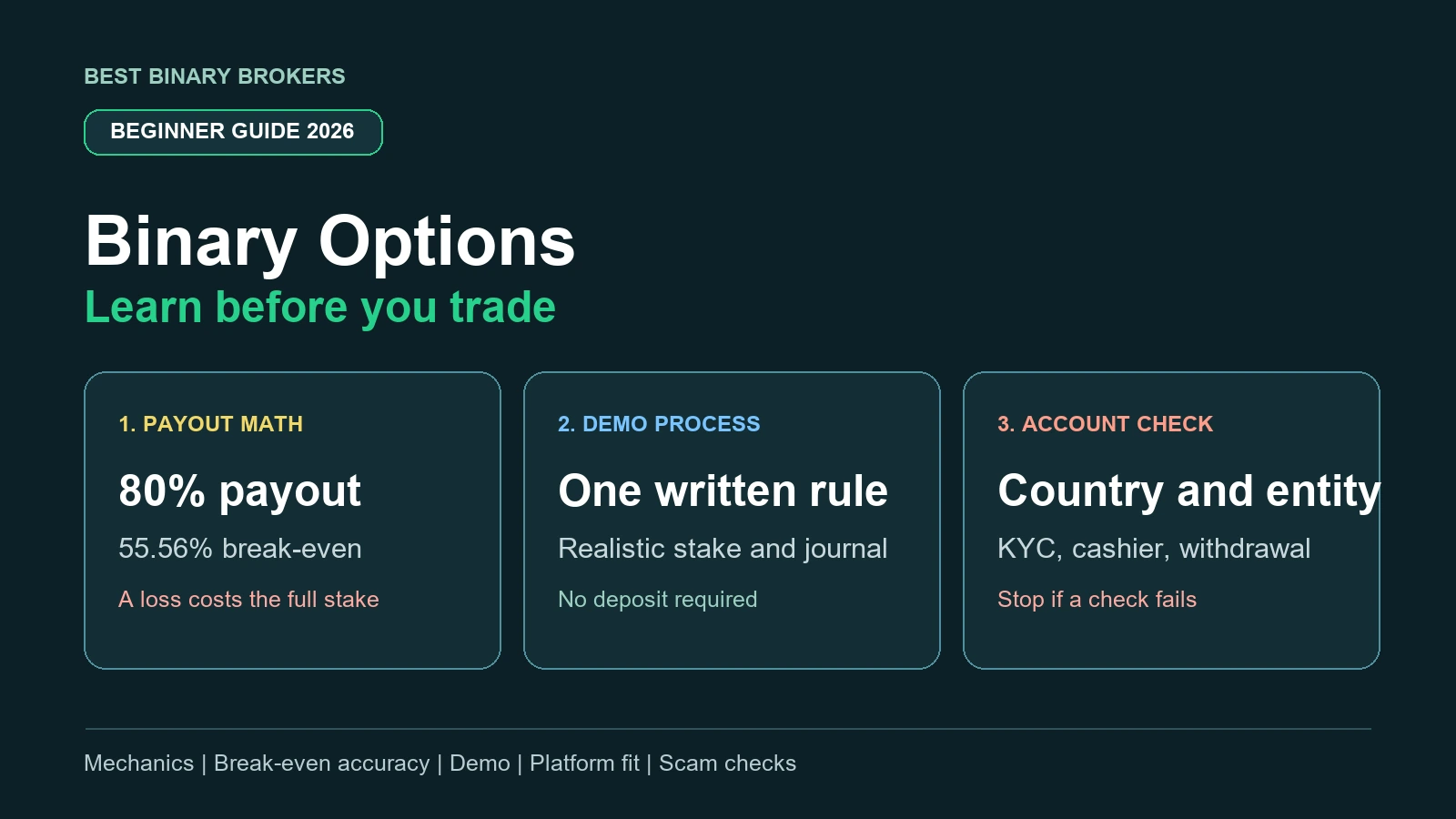
Start with the payout math, not a deposit. A conventional retail binary option can lose the full stake, while a winning trade normally returns less than the amount risked as profit. At an 80% payout, you need to win more than 55.56% of trades just to break even.

Use a realistic stake and one written setup.
Calculate the accuracy required by the displayed return.
Confirm country access, entity, KYC and withdrawal route.
Risk warning: fixed-outcome trades can lose the full stake. Demo removes funding risk, but it cannot prove profitability, execution quality or successful withdrawals.
Binary Options for Beginners: The Short Answer
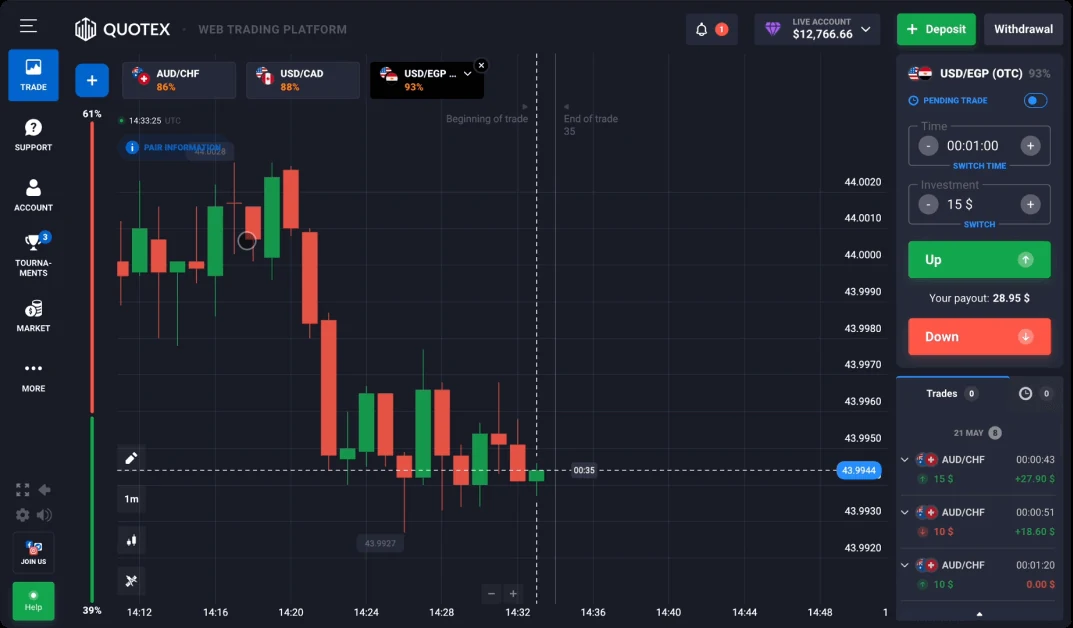
Binary options look simple because the order ticket asks for a direction, amount and expiry. The difficult part sits behind the buttons: payout imbalance, exact-time settlement, repeated full-stake exposure and the quality of the platform providing the quote. Learning the controls takes minutes; establishing an edge requires a recorded sample that beats the break-even rate after rule violations and changing payouts.
The sensible beginner path is specific: understand the contract, check whether the product and provider are available in your location, inspect the platform without funding, practise one repeatable decision in demo, and review the journal before considering a real account. A deposit is not part of the learning requirement.
| Beginner question | Direct answer | Next check |
|---|---|---|
| What is the trade? | A fixed-outcome price prediction with a stake and expiry. | Read the settlement rule. |
| What can be lost? | Usually 100% of the amount staked on a losing trade. | Set a stake and session cap. |
| What accuracy is needed? | More than 55.56% at an 80% payout to break even. | Calculate from the live payout. |
| Where should I start? | Demo, with the stake size you could actually afford. | Journal one written setup. |
| When should I deposit? | Only after legality, entity, KYC and withdrawal-route checks. | Inspect the live cashier first. |
Beginner Platform Fits: Three Different Learning Paths
The platforms below support different learning goals rather than forming a universal ranking. Quotex provides a clean manual ticket. Pocket Option is relevant when social and copy tools are the feature being evaluated. Olymp Trade suits readers who want guided education and understand that FTT and Forex are separate workflows.
| Platform fit | Public starting facts | Why a beginner may choose it | Main control |
|---|---|---|---|
| Quotex | $10 deposit, $1 trade, $10,000 demo. | Clean manual ticket with amount, time, payout and direction in view. | Fast repeat trading needs a session cap. |
| Pocket Option | $5 marketed entry, $1 trade, $50,000 demo. | The social and copy ecosystem is the main reason to consider it, but current demo access may not include every copy-trading control. | Separate manual practice from copying and promotions. |
| Olymp Trade | $10 entry, $1 trade, refillable demo. | Guided education plus distinct FTT and Forex workflows. | Choose one mode and do not mix their risk rules. |
Quotex: manual-first
Choose it when you want the shortest path from chart to amount, expiry, payout and direction. Keep practice stakes near the amount a future budget could support.
Pocket Option: social layer
Choose it when copy trading and trader rankings are the reason for opening the platform. Use demo to learn the manual ticket, then verify which social and copy controls are available before relying on them.
Olymp Trade: guided modes
Choose it when built-in learning and a refillable practice account matter. Pick FTT or Forex before the session because the order logic and loss controls differ.
18+ only. Broker buttons are sponsored affiliate links. Availability, minimums and payment methods can vary by country and account.
What the Product and Ticket Look Like
How Binary Options Work
A binary option is a yes-or-no contract tied to a condition at expiry. On a typical retail up/down ticket, you predict whether the quoted price will finish above or below the strike at a specified time. You do not buy the currency, stock, commodity or cryptocurrency shown as the underlying asset. The contract settles from the platform’s rule and reference price.
Suppose EUR/USD is quoted at 1.08000, the payout is 80%, and you stake $10 on a higher finish after five minutes. If the settlement price meets the platform’s higher condition, the original stake returns with $8 profit. If it fails, the $10 stake is lost. A price move far beyond the strike does not increase that fixed $8 profit. A miss by a tiny amount can still create the full $10 loss.
Ties need care. Some providers return the stake when the settlement price equals the strike; another contract may define the condition differently. Read the trading rules rather than assuming a third outcome. Expiry, reference quote and settlement wording are as important as direction.
Common contract types
| Contract type | Settlement question | Beginner check |
|---|---|---|
| Up/Down (High/Low) | Does the price finish above or below the strike at expiry? | Read the exact tie and settlement rule. |
| Touch/No Touch | Does the quoted price touch, or avoid, a target before expiry? | Confirm the barrier, quote source and observation period. |
| Range/Boundary | Does the price finish inside or outside a range, or remain within it for the contract period? | Confirm whether settlement depends on the expiry price or on any boundary touch before expiry. |
| Ladder | How does the price compare with several predefined strike levels under the contract rules? | Treat every rung as a separate condition with its own payout and settlement rule. |
| Ticket field | What it controls | Beginner failure |
|---|---|---|
| Underlying asset | The market whose reference price is observed. | Choosing an unfamiliar or thin market. |
| Strike or entry | The reference price used for settlement. | Watching candle color instead of the exact strike. |
| Direction | Whether the final price must be above or below the strike. | Clicking before stating the prediction. |
| Expiry | The exact time when the outcome is checked. | Using a timeframe that does not match the analysis. |
| Stake | The amount exposed to a full loss. | Increasing after a loss. |
| Displayed payout | Profit on a winning trade, usually shown as a percentage of stake. | Treating payout as probability. |
Price feed and OTC labels
The chart is a reference used by the contract, not ownership of the underlying market. Compare the symbol, timestamp and broad direction with an independent market chart before relying on a feed. Small quote differences can occur between providers, but settlement rules should identify where the platform obtains or calculates the price and how a dispute is handled.
Many retail apps use an OTC label outside normal exchange hours or for a platform-provided instrument. OTC does not automatically prove manipulation, and it does not guarantee that the displayed series matches a centralized exchange. A beginner should avoid assuming that a weekend OTC symbol is identical to the weekday currency pair with a similar name. Record it as a separate instrument, inspect the rules and never mix its demo results with the normal-market sample.
The Payout Math Beginners Must Know
The break-even formula is 1 / (1 + payout as a decimal). At an 80% payout, 1 / 1.80 equals 55.56%. Fifty wins and fifty losses on $10 stakes produce $400 of profit and $500 of losses, leaving a $100 deficit even though the trader was right half the time.
The displayed payout changes by asset, time and platform. A method that appears viable at 90% may fail at 70%. Calculate the required accuracy from the payout recorded for each trade, not from the highest number advertised on a homepage. Fees, conversion and rule mistakes raise the practical hurdle further.
| Displayed payout | $10 win profit | $10 loss | Break-even win rate |
|---|---|---|---|
| 70% | $7 | -$10 | 58.82% |
| 80% | $8 | -$10 | 55.56% |
| 85% | $8.50 | -$10 | 54.05% |
| 90% | $9 | -$10 | 52.63% |
| 95% | $9.50 | -$10 | 51.28% |
A 20-trade example
At an 80% payout and equal $10 stakes, 11 wins produce $88 profit while nine losses cost $90. The win rate is 55%, yet the series still loses $2. Twelve wins and eight losses produce $96 against $80, leaving $16. That difference can disappear when one extra impulsive trade is added, which is why the session cap belongs in the plan before the first click.
Twenty trades are useful for understanding the arithmetic, not for proving an edge. Random winning and losing streaks can dominate a small sample. Repeat the same setup across several separate batches before drawing a conclusion. The journal should retain every valid trade and every rule violation.
Binary Options Are Not Regular Options or Asset Ownership
A retail fixed-return binary option normally settles to a predetermined profit or the loss of stake. Buying a stock creates ownership; a conventional option can provide a right to buy or sell an asset and may change value before expiry; spot forex and CFDs use price movement and exit controls. These products have different legal treatment, pricing and risk.
Exchange-listed binaries or event contracts may be priced from $0 to $100 and traded on supervised venues in some jurisdictions. That structure should not be confused with an offshore website that acts as platform, quote source and counterparty. The same yes-or-no language can sit on very different legal and market infrastructure.
The joint CFTC and SEC investor alert explains the automatic yes/no settlement and warns that a large part of the online market operates outside applicable US registration requirements. Country-specific rules and regulator checks are covered in our binary options regulation guide.
Legality and Platform Risk Come Before Strategy
There is no global yes-or-no legality answer. The UK permanently prohibited firms from selling, marketing or distributing binary options to retail consumers. ESMA temporarily prohibited marketing, distribution and sale to EU retail clients from 2018 to July 2019; many national regulators then adopted permanent domestic restrictions. Australia’s retail binary-options ban remains extended until 1 October 2031. In the United States, certain binary products can trade on regulated venues; that does not authorize every offshore platform targeting US residents.
Check the regulator for your residence, the legal entity in the current terms and the restricted-country notice presented at registration. A company registration, private dispute body or generic certificate is not the same as a government licence for the product. The FCA ban statement and ASIC ban-extension release show why country context can overturn a generic broker recommendation.
- Confirm that your country is accepted in the current terms, not only in a signup form.
- Identify the entity that holds the account and the law governing disputes.
- Check regulator registers directly when a licence is claimed.
- Stop if a platform suggests bypassing a restriction with a VPN or false address.
- Treat missing terms, unclear ownership or anonymous support as a failed check.
How to Check a Binary Options Broker Before Funding
Open the public terms, company page, payment policy and withdrawal rules before sending documents or money. Then create an unfunded profile only if access is allowed. The account should show the same entity and restrictions as the public material. A polished app or large demo balance cannot replace those checks.
- Country: confirm access and local product rules.
- Entity: record the company name, address, governing law and complaint route.
- Security: use a unique password and enable available account protection.
- KYC: read which identity, address, selfie and payment evidence may be requested.
- Cashier: inspect the minimum, currency, provider, fee and ownership rule.
- Withdrawal: check minimum, same-method rules, timing language and bonus restrictions.
- Trading rules: locate price source, expiry, tie, cancellation and payout wording.
- Support: ask one precise policy question and save the answer.
Repeat the check on the device you plan to use. A mobile app may have a different publisher name, update history or login route from the web platform. Install only from the destination reached through the verified provider page, then confirm that the account domain, support address and legal links match. App-store presence is distribution, not regulatory approval.
Bonuses deserve a separate decision. A large balance credit can be paired with turnover or withdrawal conditions and may change which funds are available. Declining an unclear promotion keeps the account record easier to audit. Screenshots of the accepted terms, cashier amount and payment route are more useful than promotional email claims.
The CFTC fraud hub describes complaints involving denied reimbursement, identity theft and manipulated software. A regulator warning is not proof that every platform behaves identically; it identifies the checks that cannot be skipped.
Use Demo as an Experiment, Not a Scoreboard
A demo account is useful when it reproduces the order sequence: choose an asset, read the payout, set the expiry and stake, state the direction, place the trade and record settlement. The oversized virtual balance is a poor stake guide. If a possible live budget would make $1 equal to 2% of the account, practise with $1 rather than clicking $100 virtual positions.
Choose one liquid underlying market during its normal session, one expiry range and one written setup. Keep the sample intact when losses appear. Changing indicators after every loss or deleting trades converts practice into entertainment. Use our binary options demo account guide for the complete practice progression.
| Journal field | What to record | Why it matters |
|---|---|---|
| Setup | A rule written before the click. | Separates a method from impulse. |
| Market and time | Asset, market session, entry time and expiry. | Shows where the rule was actually used. |
| Payout | The percentage displayed before entry. | Allows a correct break-even comparison. |
| Result | Win, loss or tie under the platform rule. | Creates a complete sample. |
| Rule compliance | Yes or no, independent of result. | A lucky rule break is still an error. |
| Session state | Calm, rushed, chasing or distracted. | Finds behavioural loss clusters. |
The Demo-to-Live Gate
Moving to real money is optional. Demo success does not verify deposits, KYC, withdrawals, quote disputes or behaviour under real loss. A strategy still needs a written market condition, entry rule, expiry rule, payout floor, fixed stake and stop condition. Compare the complete sample with the payout-specific break-even rate before considering funding.
- The method has a written rule and an unedited demo sample.
- The sample beats its payout-specific break-even rate, not merely a 50% win rate.
- The minimum trade fits the stake cap. If $1 is larger than the chosen percentage, the account is too small.
- Country access, entity, KYC documents and payment ownership have been checked.
- The selected deposit method can receive a withdrawal under the current rules.
- No bonus, borrowed money or required household money is involved.
- A fixed deposit, daily loss limit and no-redeposit rule are written before funding.
If every gate passes and you still choose to trade, fund only an amount you can lose without changing bills, debt payments or savings. Start with the minimum fixed stake when it fits the plan, stop at the written trade or loss limit and do not add funds during the same session. Signals, copy trading and martingale do not remove the payout hurdle or the need for fixed limits. Our responsible trading policy covers the wider money and behaviour controls.
Beginner Mistakes That Damage the Account Fast
Trading mistakes
- Confusing a high payout with a high chance of winning.
- Changing expiry after the analysis is complete.
- Trading OTC or unfamiliar assets without understanding the quote source.
- Stacking several positions on one prediction.
- Using martingale after a normal loss.
- Switching strategy whenever the sample turns negative.
Account mistakes
- Depositing before reading withdrawal rules.
- Using a card, wallet or crypto account owned by another person.
- Accepting a bonus without understanding turnover conditions.
- Submitting inconsistent identity or address details.
- Believing a social-media profit screenshot.
- Paying an extra fee to a stranger who promises to release funds.
Deposits, KYC and Withdrawals Are Part of the Product
The cashier is not an administrative detail. A method may have its own minimum, currency conversion, fee and return route. Use a payment account in the same name as the trading profile. Save the deposit confirmation and avoid splitting payments across several methods unless the proportional withdrawal rules are clear.
Verification can involve identity, address, selfie and payment evidence. Complete profile data accurately before funding; do not upload sensitive documents to a domain or support contact you have not verified. A demo account says nothing about whether documents will be accepted.
Before depositing, read the current withdrawal minimum, processing language, bonus effect and same-method requirement. The method-specific limit shown in the live cashier is the amount that applies. Our deposit and withdrawal guide provides the complete transaction-record checklist.
Scam Signals a Beginner Should Treat as a Stop Sign
- Guaranteed daily income, a fixed win rate or a claim that losses cannot happen.
- An account manager pressures you to deposit more after a loss.
- A private message offers signals, recovery services or remote access to your device.
- The company name, address or legal terms change between pages.
- Withdrawal requires a new tax, insurance or unlocking payment sent to an individual wallet.
- Support asks for a password, one-time code or full card security code.
- A platform claims regulator approval that cannot be found on the regulator’s own register.
- Promoters show balances and winning clips without complete account history.
Investor.gov records complaint categories including blocked reimbursements, identity theft and software manipulation. Stop sending money when a withdrawal problem produces a demand for more money.
Final Beginner Verdict
Binary options are easy to operate and hard to trade well. The first useful skill is not predicting the next candle; it is recognizing the payout hurdle, limiting repeated exposure and rejecting an account that fails legal, entity, KYC or withdrawal checks.
For platform fit, Quotex is the cleanest default for manual demo practice. Pocket Option makes sense when social and copy functions are the deliberate learning target. Olymp Trade is the stronger guided path when the reader wants education and can keep FTT separate from Forex. Use the relevant review before funding, and use the Quotex vs Pocket Option comparison when the decision is between the first two.
Continue With the Right Guide
Binary Options for Beginners FAQ
The order screen is easy to understand, but the payout structure is difficult to beat. A beginner should learn the break-even math, verify the platform and use demo before deciding whether any real-money trade is justified.
You choose an underlying asset, a direction, an expiry time and a stake. If the price finishes on the required side of the strike under the platform rules, the trade pays the displayed fixed return; otherwise the stake is usually lost.
A conventional retail binary option can lose the full amount staked on that trade. The loss is fixed before entry, but rapid expiries make it possible to repeat that full-stake risk many times in one session.
The answer depends on the payout. A 70% payout requires about 58.82% winning trades, an 80% payout requires 55.56%, and a 90% payout requires 52.63%, before any other cost or execution difference.
Yes. Demo is the right place to learn the ticket, test a written rule and build a journal. It cannot prove that withdrawals will work or reproduce the emotion of losing money, so it is necessary practice rather than proof of profitability.
Quotex has the clearest manual workflow in our shortlist. Pocket Option fits readers who specifically want social and copy tools. Olymp Trade fits readers who want guided education and a choice between FTT and Forex modes.
Legality depends on the product, provider and reader's location. Retail binary options are prohibited in the UK and Australia, while national product-intervention measures apply across EU Member States. The United States permits certain products only on regulated venues. Check a local regulator before opening an account.
Winning trades are possible, but a few wins do not establish a positive method. Because a loss is commonly 100% of stake while a win pays less, the trader needs sustained accuracy above the break-even rate and strict control of repeated trades.