Binary Options Deposit and Withdrawal Guide 2026
For most users, the strongest payment route is an account in their own name that works for both deposit and withdrawal. Cards and bank transfers leave the clearest conventional trail, e-wallets favour account-to-account convenience, and crypto suits users who already understand network and address risk.
Already waiting for funds? Go to pending or rejected withdrawal steps.

Which Payment Method Should You Choose?
Our payment-method verdict: use a card or bank transfer when a familiar statement trail matters most, an e-wallet when it is available for both directions and convenience is the priority, and crypto only when network handling is already routine. Using one owned method in both directions usually creates fewer ownership and return-to-source conflicts than splitting funds across several rails.
Best Binary Options Payment Methods: Speed, Cost and Control
| Method | Best for | Speed tendency | Possible costs | Withdrawal support | Main failure point |
|---|---|---|---|---|---|
| Card | A familiar bank statement and simple first route. | Deposits are often quick; returns can pass through platform review and card settlement. | Issuer conversion, processor or cross-border charges. | Strong when return-to-card is available; excess funds may need another verified route. | Cardholder mismatch, unsupported return or an expired/replaced card. |
| Bank transfer | The clearest named sender, beneficiary and reference trail. | Usually slower than wallets; settlement follows banking days and intermediaries. | Transfer, intermediary and foreign-exchange charges. | Useful where the same named account can receive the return. | Wrong reference, beneficiary details or a slow intermediary bank. |
| E-wallet | Convenient account-to-account movement with its own ledger. | Often quick after approval, but provider and country coverage vary. | Wallet, conversion or withdrawal charges. | Good only when the wallet appears on both sides of the live cashier. | Deposit-only availability or a wallet profile that does not match the trader. |
| Crypto | A public network hash and cross-border availability. | Network confirmation can be quick; platform review remains separate. | Network, exchange, spread and conversion costs. | Works when the exact asset, network and destination are supported for return. | Wrong chain, address or memo/tag; the transfer is normally irreversible. |
No row promises a universal processing time. Platform review comes first; the bank, wallet, card network or blockchain completes a separate settlement stage. The live cashier decides which route exists for a particular country, currency and profile.
Broker Payment Fit: Quotex, Pocket Option and Olymp Trade
The payment distinction is narrower than general platform fit: Quotex publishes the clearest small-withdrawal baseline, Pocket Option gives the most detailed same-method and proportional-routing rules, and Olymptrade makes the strongest first-party speed claim. These are public policy and marketing statements, not independently measured results.
| Platform | Payment fit | Current public baseline | Main caution | Full review |
|---|---|---|---|---|
| Quotex | The clearest published small-withdrawal baseline and same-method rule of the three. | Official FAQ: $10 deposit; most withdrawals from $10, crypto from $50 and an average 1–5-day procedure. | The payment policy and live cashier control same-method routing, verification and method limits. | Read Quotex review |
| Pocket Option | The most explicit public-offer routing: the original method and details, with proportional returns after deposits through several methods. | Marketing pages frame entry from $5. The current public offer sets a $10 withdrawal baseline and processing within three business days, extendable to 14 business days after notice. | The offer’s deposit floor is $0.1 unless another amount is specified, so the live cashier can differ from the $5 marketing entry. | Read Pocket Option review |
| Olymp Trade | The strongest public withdrawal-speed proposition, presented as Olymptrade’s own processing statistics rather than our test. | Public materials frame deposits from $10 and withdrawals from $10 or the local-currency equivalent; Olymptrade reports over 70% processed within one hour and most others within 24 hours. | Timing depends on method. Most withdrawals are fee-free, with stated exceptions for USDT, crypto and some non-trading activity. | Read Olymp Trade review |
The three green buttons are sponsored affiliate links. Public baselines were rechecked in July 2026; the amount and method inside the logged-in cashier take priority.
Deposit Acceptance and Withdrawal Eligibility Are Different
A deposit proves only that one payment instruction reached the account. It does not establish that the profile is fully verified, that the method can receive returned funds, that a bonus has no effect, or that a future request meets the minimum and ownership rules. Treat deposit and withdrawal as two connected but separately controlled processes.
A method logo on a public page is not an account offer. Availability can change by country, currency, device or profile status. The policy explains the general order, while the logged-in cashier supplies the method-specific amount and destination.
The CFTC and SEC binary options alert describes complaint patterns that include denied reimbursements and identity misuse. That warning does not make every delay fraudulent; it does make ownership records and a usable complaint channel part of the funding decision.
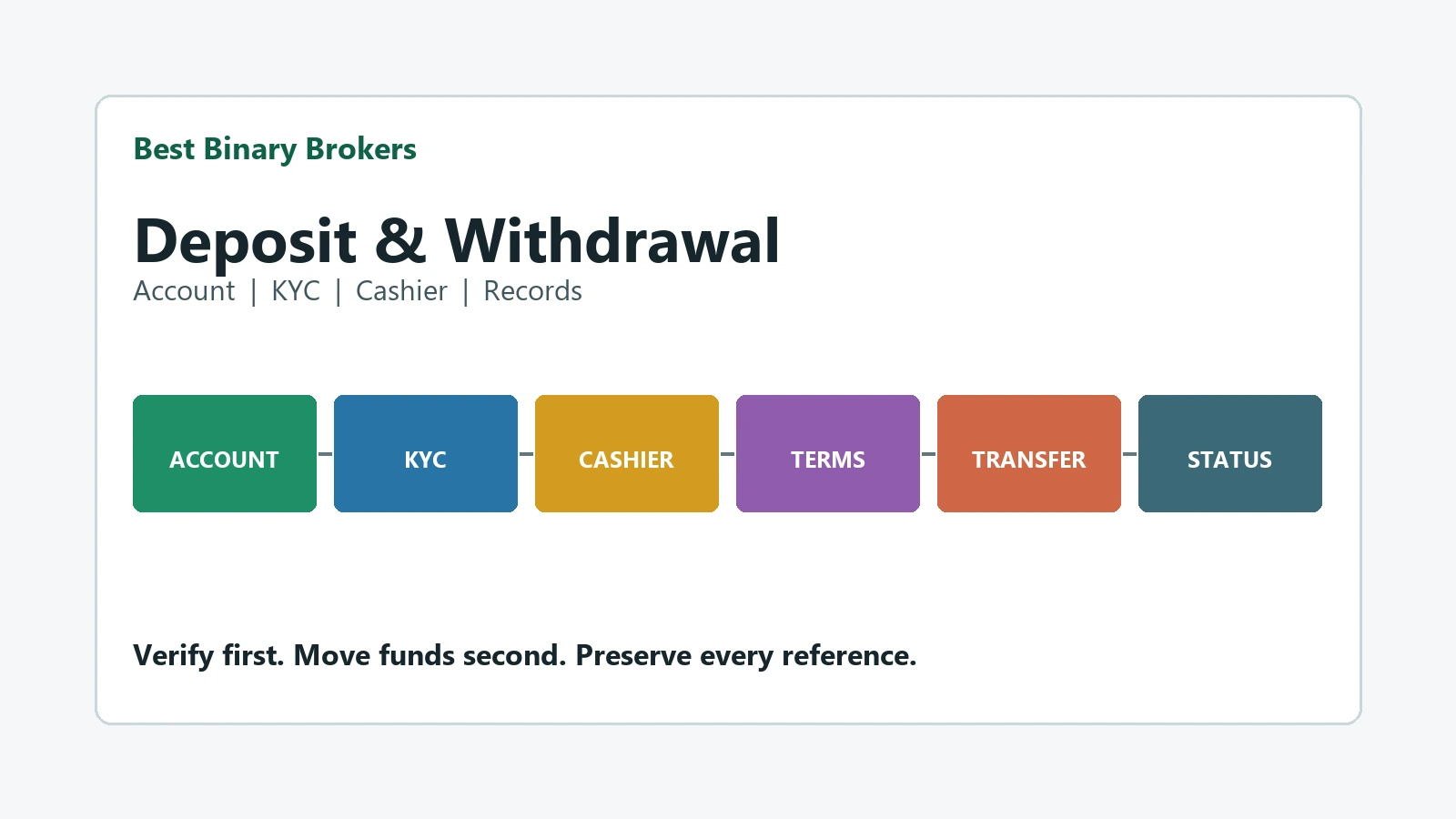
A Six-Stage Deposit and Withdrawal Workflow
Use the workflow in order. The first four stages happen before money moves. The transfer and status stages create the evidence needed if a processor, bank, blockchain network or platform later needs to trace the payment.
| Stage | Record before continuing | Stop signal |
|---|---|---|
| 1. Account | Legal name, country, serving company and product. | The profile is inaccurate or the serving company is unclear. |
| 2. KYC | Required identity, address and payment-ownership documents. | Documents are requested through an unofficial contact. |
| 3. Cashier | Available deposit and withdrawal methods, currencies, limits and fees. | A deposit route appears but the return route cannot be explained. |
| 4. Terms | Same-method order, bonus effect, review stages and complaint channel. | Important conditions exist only in chat or marketing copy. |
| 5. Transfer | Quote, amount, fee, transaction ID, owner and timestamp. | The destination or payment owner changes unexpectedly. |
| 6. Status | Platform, processor and settlement status with case numbers. | Support asks for another deposit or an off-policy release payment. |
Payment Ownership and Same-Method Rules
Use a card, bank account, e-wallet, exchange account or wallet that belongs to the trading-account holder. A transfer from a relative, employer, promoter, shared wallet or borrowed card can be credited and still create a later ownership conflict. Accurate profile details and own-name payment records reduce that avoidable mismatch.
Many providers apply a return-to-source sequence. Deposited card funds may return to the card up to an eligible amount, while another verified method receives the remainder. Other accounts require the original wallet or bank route. When the sequence is not stated, support should identify it in writing before money moves.
Splitting deposits across several methods can create proportional or ordered withdrawals. Avoid method switching merely to chase a faster deposit. One documented route is easier to reconcile than several currencies, owners and processors.
KYC and Payment Ownership
KYC can appear at registration, before trading, after a payment change or during withdrawal review. A request arriving later is not automatically evidence of wrongdoing, but it should come through an authenticated account or official channel and match the published policy. Never send identity documents to a promoter or an unverified social-media contact.
- Identity: a government-issued document and, where required, a liveness or selfie step matching the trading profile.
- Address: an accepted statement, bill or official record when country or residence needs verification.
- Payment ownership: masked card, bank, wallet or exchange evidence showing the account holder rather than a third party.
- Source of funds: income or transaction evidence when a legitimate account review requires it.
Card security codes, private keys, recovery phrases and unrelated balances do not belong in an upload. The account email and phone should also be protected with available two-factor controls.
Binary Options Deposit and Withdrawal Fees
A public minimum is only the entry figure. The real cost can include card or bank charges, processor fees, blockchain network fees and currency conversion at either end. Compare the amount debited from the payment account with the amount credited to the trading ledger; those two figures reveal the effective funding cost.
The same arithmetic works for every method: debit amount minus trading-ledger credit, then withdrawal instruction minus final payment-account credit. Minimums, currencies and fee sources should be taken from the live transaction screen, because another account’s screenshot cannot set the terms for the current user.
Binary Options Withdrawal Times by Method
A withdrawal duration has at least two parts: provider review and external settlement. Provider review can include account, ownership, bonus or security checks. After release, a wallet, card network, bank, exchange or blockchain completes its own process. Weekends, business days, intermediary institutions and network congestion can affect the second stage.
A generic claim such as “withdrawal in 24 hours” is incomplete unless it names the stage. A sent status should have an external trace reference; a pending status should still sit inside a stated review window or carry a specific review reason.
| Status | What it usually means | Next evidence-based step |
|---|---|---|
| Created | The request exists but review may not have started. | Save the request ID, amount, method and timestamp. |
| Pending review | The provider is checking account or payment conditions. | Read the stated review window and check for a legitimate document request. |
| Approved / sent | The provider reports release to a processor or network. | Request the processor reference, bank trace or transaction hash. |
| Returned / reversed | The destination rejected or returned the transfer. | Ask which institution returned it and confirm destination details. |
| Rejected / cancelled | A rule, document, limit or method blocked the request. | Ask for the exact reason and policy clause in writing before any new action. |
Trace a Missing or Incorrect Deposit Before Sending More
When a deposit is missing, start with the debit record instead of repeating the payment. The institution may show pending, completed, reversed or declined; that state, together with amount, currency, destination, reference and timestamp, identifies where tracing begins. A second transfer can create two unresolved transactions rather than repair the first.
Cards and banks have authorization, posting and settlement stages. A wallet can show sender-side completion while the receiver still lacks a matching reference. A blockchain transfer can be confirmed on the correct network but omit the required memo or tag. The useful support question is which identifier is missing and which institution currently controls the transfer.
If the trading ledger credits a different amount, reconcile payment debit, processor charge, conversion and account credit. A reversed payment should also have both the original debit and returned credit. Platform and payment-institution cases need the same amount, currency, date and transaction reference.
Read Bonus Terms Before Accepting a Promotion
Bonus turnover, trade-volume, expiry, cancellation or account-balance conditions can affect when deposited funds, promotional funds or gains become eligible for withdrawal. Read the specific terms rather than relying on a banner percentage or a promoter’s summary.
The decision fields are required volume, qualifying products, deadline, maximum stake, cancellation process and treatment of existing funds. Decline the promotion when those terms are unclear or when the activity would force more trades than the written plan allows.
A promotion should never be used to justify a larger deposit. The responsible trading guide covers money and behaviour limits; the payment page is concerned with whether the promotion changes the return path.
The Transaction Record That Solves Payment Questions
A useful record connects the account, cashier instruction, transfer, policy and any support case without exposing credentials. It contains:
- account owner, country, currency, serving company and account ID;
- cashier method, limits, fees, currencies and timestamp;
- amount, fee, transaction ID or hash and destination;
- payment, KYC, bonus and withdrawal terms in force at the time;
- case number, dates, replies and the promised next action.
Originals belong in private storage. A redacted working copy can be shared with the provider or payment institution, but identity documents, recovery phrases, private keys, full card numbers, passwords and one-time codes should never become public evidence.
What to Do When a Withdrawal Is Pending or Rejected
- Stop changing the account. Do not add another deposit, accept a new bonus, change names or open a second profile while the request is unresolved.
- Capture the current status. Keep the request ID, amount, method, timestamps and messages shown in the cashier.
- Get the precise reason. Request the policy clause, missing document or processor reference in writing through official support.
- Answer legitimate KYC requests carefully. Use the authenticated upload route and retain confirmation of submission.
- Contact the payment institution promptly. Trace, recall or dispute options may exist for an unauthorized, mistaken or misdirected transfer. Availability depends on method, facts and time.
- Use the named complaint route. Follow the provider’s formal process and the relevant authority or payment-institution channel for your jurisdiction.
Never pay an individual who says a tax, insurance charge, verification fee or second deposit will release the balance. The FTC refund and recovery scam guidance warns that recovery scammers target people who have already lost money and ask for an upfront payment or financial information.
Global Rules and Regional Payment Routes
This guide covers the global workflow. Local rails belong to their regional pages: the Brazil Pix guide owns Pix, PSP and MED context, while the Nigeria payment-method guide covers NGN routes and local KYC conditions. These are related guides, not alternate-language copies.
Use the global broker ranking for the wider platform shortlist, the beginner guide for contract and payout basics, and the regulation guide for entity and jurisdiction checks. The Quotex minimum deposit guide owns the narrower $10 funding question.
A Practical Rule for the First Transfer
Use one payment account in your own name, choose a route supported for both deposit and withdrawal, complete verification early and keep the first transaction small enough to trace easily. Card or bank is the default when a conventional statement trail matters most; e-wallet is the convenience choice when it appears in both directions; crypto is a specialist route for users who can validate every network field.
A credited deposit is still not proof of withdrawal performance. The decisive result is a complete round trip with understandable ownership, fees, conversion and settlement records, without adding money merely to release a pending balance.