2026 broker comparison | Updated July 30, 2026
Quotex vs Pocket Option 2026: Payouts, Demo & Winner
Quotex is the overall winner for most traders. Its focused manual terminal is faster to learn and easier to control. Pocket Option wins for copy trading, social tools and the lower advertised $5 entry.

Risk warning: fixed-outcome trades can lose the full amount staked. Availability and account terms vary by country.
Quick Verdict: Quotex Wins Overall
Choose Quotex when the goal is straightforward manual trading. Its screen keeps the chart, selected asset, investment, expiry, displayed return and Up/Down controls close together. The platform asks for fewer decisions before each order, which gives it the stronger beginner route and our overall recommendation.
Choose Pocket Option when copy trading is the reason for opening an account. It has trader rankings, social activity, copy controls, tournaments, achievements and a larger set of visible tools. It also advertises a $5 real-account start, half the $10 minimum shown by Quotex.
Pocket Option offers more features; Quotex offers the more focused product. For most readers comparing only these two platforms, focus matters more than another menu of tools. That is why Quotex finishes first.
| Category | Winner | Decision |
|---|---|---|
| Overall choice | Quotex | The cleaner manual terminal makes it the better default for most readers. |
| Copy trading | Pocket Option | Trader rankings, social activity and copy controls are built into the platform. |
| Lowest advertised entry | Pocket Option | $5 versus the $10 Quotex minimum-deposit baseline. |
| Beginner manual trading | Quotex | Amount, expiry, displayed return and direction stay in one compact routine. |
| Feature variety | Pocket Option | More indicators, social tools, tournaments, achievements and promotions. |
| Mobile simplicity | Quotex | The smaller feature set is easier to scan on a phone. |
| Payouts | Live comparison | The percentage changes by asset, expiry and session on both platforms. |
| Withdrawals | No fixed winner | Published windows differ, while method and account review control each request. |
Quotex vs Pocket Option Head-to-Head
The largest practical difference is platform design. Quotex behaves like a dedicated manual terminal. Pocket Option combines a manual ticket with social trading, rankings, rewards and extra account activity. Both provide low entry amounts, $1 trades and large demo balances, but they lead users into different routines.
| Feature | Quotex | Pocket Option |
|---|---|---|
| Best for | Focused manual digital-options trading. | Copy trading, social tools and a broader account ecosystem. |
| Advertised real-account start | $10 minimum deposit. | $5 real-account starting amount. |
| Minimum trade | $1. | $1. |
| Demo balance | $10,000 virtual funds. | $50,000 virtual funds. |
| Public return headline | Up to 98% on a digital option. | Up to 92% on Quick Trading; Express trades can display up to 218%. |
| Advertised instruments | 410+ trading instruments. | 100+ global assets. |
| Copy trading | No central public copy feature. | Available through rankings and social-trading controls. |
| Platform style | Compact chart and order ticket. | Feature-rich trade room with social and promotional layers. |
| Withdrawal baseline | $10 for most methods; many crypto routes start at $50. | $10 unless another method or account limit applies. |
The advertised deposit gap is only $5, so it should not decide the entire comparison. A $1 trade consumes 10% of a $10 balance and 20% of a $5 balance. The lower entry makes Pocket Option easier to open, while Quotex remains the better environment for learning a controlled manual process.
Compare the Two Platforms
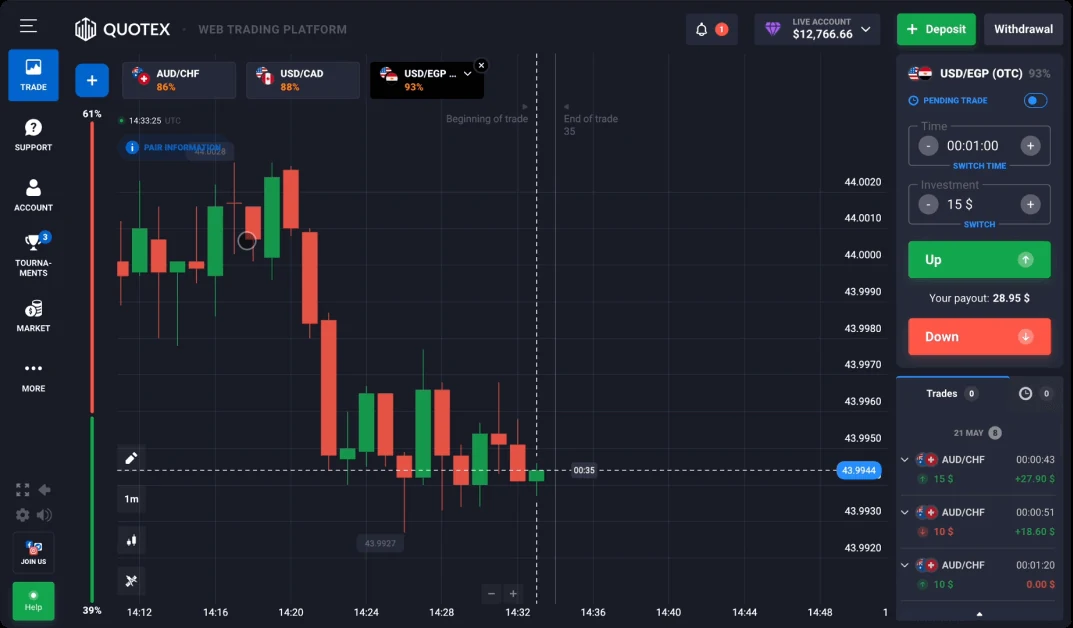
Quotex: best overall
$10 deposit | $1 trade | $10,000 demo
Best for a clean chart-first experience, manual entries and a shorter learning path. Quotex keeps the trading decision in the foreground and wins our 2026 comparison.
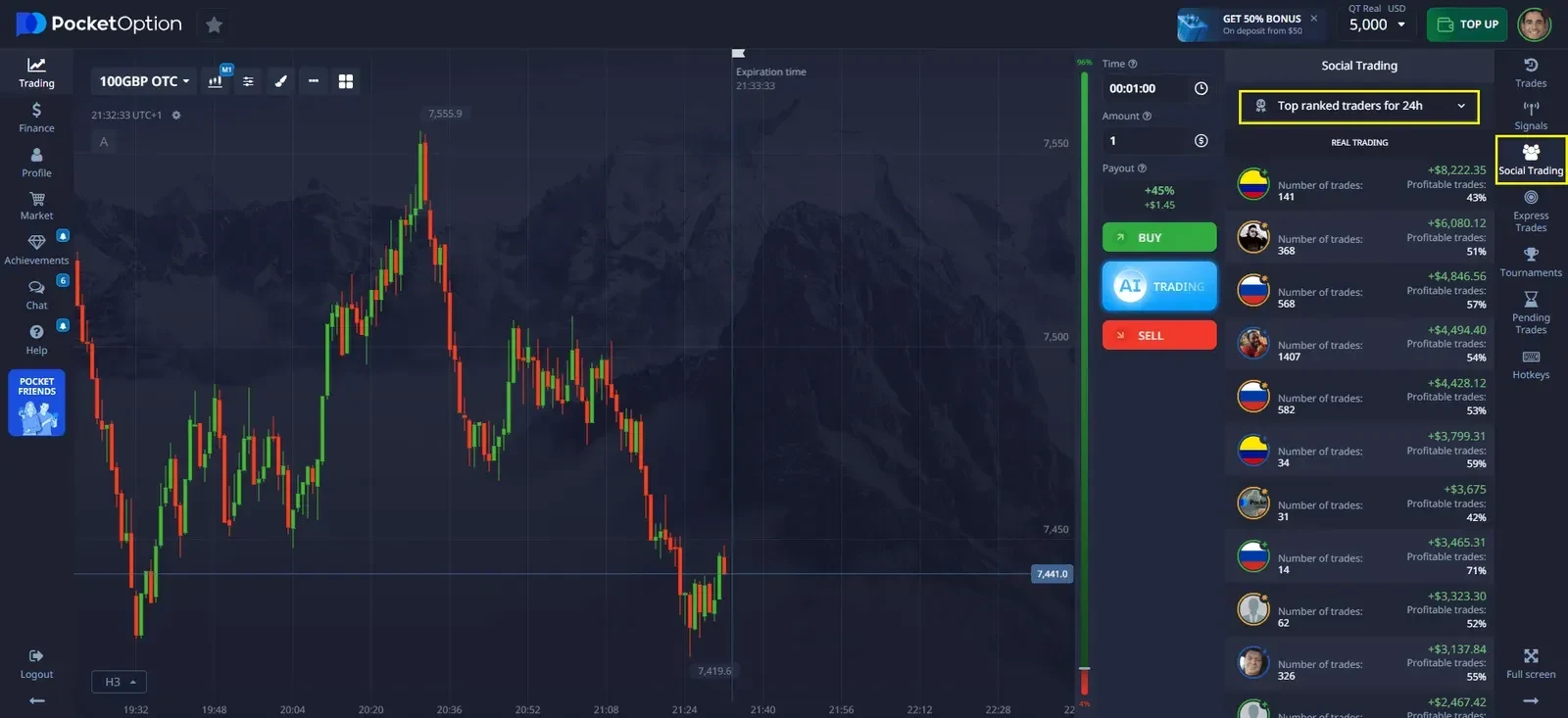
Pocket Option: best for features
$5 start | $1 trade | $50,000 demo
Best for copy trading, social rankings, tournaments and a wider toolkit. Pocket Option is the stronger specialist platform when those features will actually be used.
Which Platform Is Easier for Manual Trading?
Quotex wins manual trading. A typical order follows a short sequence: choose the asset, set the amount and expiry, read the displayed return, then select direction. The chart and ticket stay visually connected, so a beginner can understand what changes the contract before pressing a button.
Pocket Option retains the same basic decisions but surrounds them with more account activity. Indicators, signals, rankings, chat, achievements and promotions can help an experienced user explore the platform. For a new manual trader, they create more places to look and more reasons to remain active.
The simpler screen also helps on mobile. A phone already compresses the chart and trade ticket; Quotex places fewer competing elements around them. Pocket Option is more versatile, while Quotex is easier to read at a glance.
| Decision point | Quotex | Pocket Option | Best fit |
|---|---|---|---|
| Place a manual trade | Short path from asset to amount, expiry and direction. | Same core ticket inside a denser workspace. | Quotex |
| Explore chart tools | Compact indicator set for a focused routine. | Broader visible menu of indicators and drawing tools. | Pocket Option |
| Use social trading | Manual-first experience. | Rankings, profiles and copy controls. | Pocket Option |
| Practise in demo | $10,000 virtual account with a simple manual ticket. | $50,000 virtual account with more features to explore. | Depends on goal |
| Trade on a phone | Cleaner screen with fewer competing panels. | More tools and account activity on mobile. | Quotex for simplicity |
Copy Trading and Social Features
Pocket Option wins this category by a wide margin. Its social-trading area presents trader profiles and rankings, and its public guidance describes automatic copying. Users can explore another trader’s recent activity and configure copy settings instead of entering every position manually.
This feature appeals to readers who want an active community and a ready-made source of trade ideas. Rankings, tournaments and achievements also make the account feel more interactive than the narrower Quotex terminal.
Quotex is the better choice when every trade should remain a direct manual decision. It has no comparable social layer at the centre of the product. The absence of copy tools is a disadvantage for social traders and an advantage for users who prefer a quieter workspace.
Payouts, Assets and Expiry Times
Quotex publishes digital-option returns of up to 98%. Pocket Option advertises up to 92% on Quick Trading, while Express trades can display returns of up to 218%. The directly comparable figure is the live return on the same quick-trading asset and expiry, where Quotex holds the stronger published ceiling.
At an 88% displayed return, a correct $1 position produces $0.88 profit and an incorrect position loses the $1 stake. The break-even win rate is about 53.2%. At an 80% return, it rises to about 55.6%. A small payout difference changes the number of winning trades required to stay above break-even.
For a fair comparison, open the same asset category and expiry on both platforms at the same time. Quotex usually gives the percentage more visual prominence beside its compact ticket. Pocket Option makes more surrounding tools available. We give Quotex the presentation advantage, but the higher live percentage wins the individual trade comparison.
Demo Accounts: $10,000 vs $50,000
Pocket Option wins on the advertised virtual balance with $50,000, compared with $10,000 at Quotex. The larger demo balance is useful for exploring manual trades, indicators, signals, chart tools and the MT Forex demo without repeatedly resetting the account. Social Trading, tournaments, achievements and rewards belong to the real-account environment rather than the standard demo.
Quotex offers the better first manual demo. Its smaller feature set makes it easier to practise the exact amount, expiry, payout and direction sequence. A reader learning the basic contract gains more from a realistic $1 stake than from the largest virtual number on screen.
Use Quotex demo for a focused manual routine. Use Pocket Option demo to explore its broader charting, signals and platform toolkit. Evaluate copy trading, social rankings and tournaments separately because those features are not available in the standard demo. Our binary options demo account guide has a reusable practice and journal format.
Minimum Deposit, Fees and Bonuses
Pocket Option wins the entry-price comparison. It advertises a $5 real-account start and $1 minimum trades. Quotex lists a $10 minimum deposit and the same $1 minimum trade. The difference is meaningful for access, although neither starting balance gives much room for position sizing.
Quotex presents bonuses as an optional account feature. Pocket Option gives promotions, rewards and achievements greater visibility. Readers interested in bonus offers will find more activity at Pocket Option; readers who want a plain deposit and manual ticket may prefer the simpler Quotex route.
Payment-method availability and conversion charges can change with country and currency. The dedicated Quotex minimum deposit and Pocket Option minimum deposit pages cover the current cashier rules without expanding this comparison into two payment guides.
Withdrawals and Processing Times
Quotex publishes an average withdrawal time of one to five days. Its minimum is $10 for most payment systems, while many cryptocurrency methods start at $50. The FAQ also lists a 3% fee on each request from the third withdrawal made within one day.
Pocket Option’s Public Offer uses a $10 withdrawal baseline unless another account or method limit applies. It gives a three-business-day processing window and allows an extension in specified cases. Separate payment wording refers to five business days, with provider or bank processing adding more time outside the platform.
Identity verification and payment method records can be requested on both accounts. Matching profile and payment details reduce avoidable delays when a request enters review.
| Money question | Quotex | Pocket Option | Result |
|---|---|---|---|
| First deposit | $10 public minimum. | $5 advertised start. | Pocket Option starts lower. |
| Minimum position | $1. | $1. | Tie. |
| Published withdrawal minimum | $10 for most methods; crypto often starts at $50. | $10 unless another limit applies. | Pocket Option is lower for many crypto comparisons. |
| Published processing | Average of one to five days. | Three business days in the Public Offer, with documented extensions; separate payment wording uses five business days. | No universal speed win. |
| Repeated-request fee | The FAQ lists 3% from the third withdrawal in one day. | Current account and provider charges apply. | Quotex rewards fewer requests. |
| Bonus emphasis | Offers can appear but are not the main platform identity. | Promotions and rewards are more prominent. | Pocket Option offers more promo activity. |
Neither broker earns a permanent withdrawal-speed win from these published windows. Quotex gives the simpler headline average; Pocket Option often presents the lower crypto threshold. The exact payment route decides the practical result. See the deposit and withdrawal comparison for the full records checklist.
Mobile App and Phone Trading
Quotex wins for mobile simplicity. Its browser-first terminal keeps the chart and core trade controls close together, with fewer panels competing for limited screen space. Readers who mainly trade manually can move through the order ticket with less visual clutter.
Pocket Option wins for mobile feature access. Its ecosystem extends beyond the basic trade room and includes social tools, account activity and an Android route. It is the better choice for users who want the broader platform available from a phone.
For a clean manual screen, pick Quotex. For copy trading and more account features, pick Pocket Option. Use only the platform route available from the approved broker CTA or the relevant official app listing.
Safety, Regulation and Country Access
Neither platform receives a top-tier regulation win. Quotex currently names ON SPOT GROUP LLC in St. Kitts and Nevis. Pocket Option public terms use an offshore company and Costa Rican governing-law route. These arrangements provide less retail protection than a strongly supervised domestic broker.
Country restrictions also matter. Quotex lists unavailable regions that include the United States, Canada and EEA countries. Pocket Option terms restrict the United States, Canada, EEA states and additional locations. Readers should use truthful registration details and leave the platform when the real country is blocked.
This safety tie changes neither product verdict: Quotex remains our manual-trading winner and Pocket Option remains the copy-trading winner. Readers who require top-tier retail oversight should use the binary options regulation guide before choosing any offshore platform.
Pocket Option vs Quotex: Who Should Choose Each Platform?
Choose Quotex when
- You want a clean manual terminal.
- You prefer fewer social and promotional distractions.
- You mainly trade from a phone.
- A $10 starting deposit fits your comparison.
Choose Pocket Option when
- Copy trading is a required feature.
- You want rankings, tournaments and achievements.
- The $5 advertised start matters.
- You prefer a larger demo balance and more tools.
The decision is simple: Quotex for focused manual trading, Pocket Option for the wider social ecosystem. A reader who has no use for copy trading gains little from choosing the more complex platform.
Final Verdict: Quotex or Pocket Option?
Quotex is our winner in 2026. It offers the clearer manual workflow, the shorter beginner learning path and the better mobile experience for readers who want to control every trade themselves.
Pocket Option is the best alternative for copy trading. It also wins for social tools, tournaments, the $50,000 demo balance and the lower advertised $5 entry. Those advantages are strong enough to change the choice when features matter more than simplicity.
How We Compared the Platforms
The comparison uses the current Quotex homepage, FAQ, app materials, company footer and payment wording. Pocket Option facts come from its platform page, quick-start material, Public Offer, payment policy and current interface materials. The review date is July 30, 2026.
Category winners are based on product design, public entry figures, demo access, manual workflow, copy capability, mobile use and documented payment terms. Payout and withdrawal figures are presented as current published baselines because they can change with the selected asset, method and account.
Review methodology explains the scoring and update process. Editorial policy explains corrections, affiliate disclosure and source handling.