Major-market legal-status guide
Binary Options Regulation 2026: Major Markets and License Checks
Binary options are not governed by one worldwide rule. In the United States, binary options may be offered through appropriately regulated market structures, while the UK prohibits retail distribution and the EU, Australia and Canada apply major retail restrictions. In every market, a website opening on your phone is not proof that the exact firm and product are authorized for you.

Regulation, Registration and Product Permission
Three different questions are often compressed into “is this regulated?”: whether the company exists, whether it is authorized to provide a financial service, and whether it may offer this exact contract to a retail resident. A reliable check answers all three and then confirms the domain.
| Question | Reliable 2026 answer | What to verify |
|---|---|---|
| Is the website accessible? | Access proves only that the page loaded. | Country eligibility, serving entity and product permission. |
| Is the company incorporated? | Incorporation confirms a legal record, not financial supervision. | Regulator, authorization status and permitted services. |
| Is a license number shown? | A number can be unrelated, expired, copied or issued for another activity. | Exact entity, number, domain, status and scope in the official register. |
| Is binary trading allowed? | Rules differ by country and client type. | Whether providers may market or sell the exact contract to a retail resident. |
| Is there a dispute body? | A private membership may offer mediation but is not automatically a regulator. | Binding powers, eligibility, award limits and enforcement route. |
| Does regulated mean safe? | No. Oversight does not remove all-or-nothing trading losses. | Product risk separately from firm and custody risk. |
The strictest useful rule is simple: if the official register cannot connect the legal entity, permission, product, jurisdiction and website, treat the claim as unverified. Do not fill the gap with a badge, a company certificate or an influencer’s screenshot.
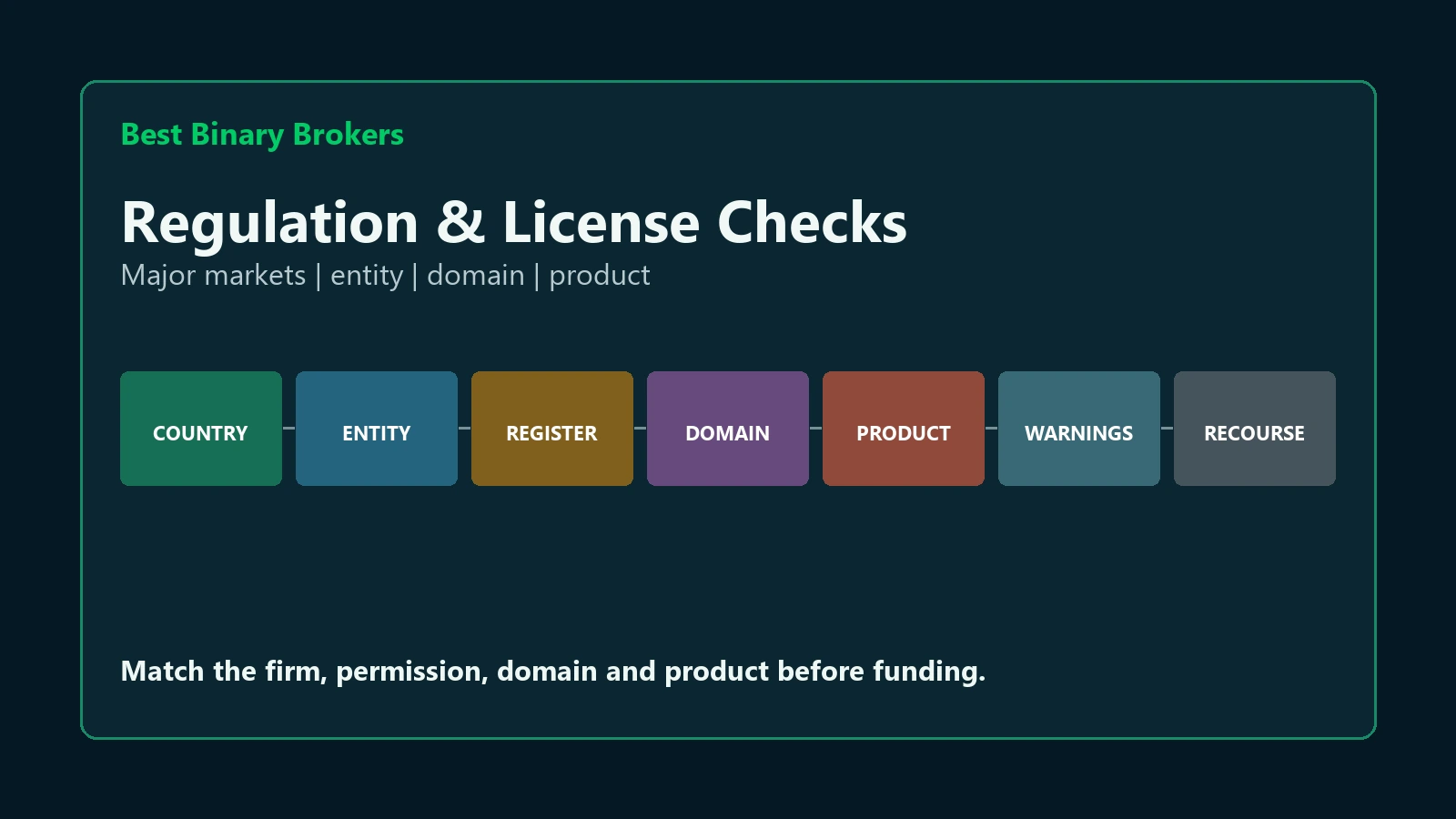
The 7-Step Binary Options Authorization Check
- Identify your jurisdiction. Use your legal residence and client classification, not a VPN location, travel address or the currency displayed by the site.
- Name the serving entity. Find the company named in the account agreement, privacy notice, payment descriptor and complaint section. A brand can route customers to different companies.
- Open the official register yourself. Search through the regulator’s own domain. Do not rely only on a certificate image or a link embedded in a sales message.
- Match the record. Compare legal name, number, current status, address, approved domains and contact details. One mismatch is enough to stop and investigate.
- Read the permission scope. Confirm that the entity may provide the relevant investment or derivatives service. A payment, crypto, education or company license is not automatically a binary-options permission.
- Check product and country restrictions. A firm can be authorized for one activity while retail binary contracts are prohibited or outside its permissions.
- Search warnings and recourse. Check regulator alerts, clone notices, disciplinary history, compensation eligibility and the complaint path before opening the cashier.
What Regulation Proves, and What It Does Not
A financial authorization is meaningful because it can attach rules, supervision and enforcement to a named legal person. Depending on the jurisdiction and service, that may include capital requirements, governance, disclosures, complaint handling, conduct standards, client-asset arrangements or reporting. Those protections vary; the word “regulated” is not a universal package.
It is equally important not to overstate the result. A licensed company can still offer several products under different entities, and a permission may exclude the contract shown on a global website. Regulation also cannot turn a fixed all-or-nothing payoff into a low-risk product. Verify the firm and product, then assess the trade itself.
| Claim or document | What it can establish | What it does not establish |
|---|---|---|
| Company incorporation | A named company exists in a corporate registry. | Permission to provide investment services or binary options. |
| Brand or trademark | A commercial name or logo is in use. | Which entity holds client money or enters the contract. |
| Industry association / dispute membership | Membership under that body’s own rules. | Government supervision, capital rules or a compensation scheme. |
| Financial-services authorization | The entity has listed permissions in a jurisdiction. | That every product, domain and foreign customer is covered. |
| Product and venue permission | The regulator permits the service and contract on the stated venue. | A profitable result or freedom from operational failure. |
| No warning found | No matching notice appeared in the search performed. | Positive authorization or approval. |
Labels such as “registered company,” “internationally regulated,” “certified platform” or “member of a financial commission” remain incomplete unless the official record connects the entity, domain, permission, product and jurisdiction. Likewise, absence from a warning list is not positive authorization. Readers searching for regulated binary options brokers should expect that qualified evidence, not a logo grid.
Regulated Exchange vs Offshore OTC Platform
The most important structural split is not a homepage design or payout percentage. It is where the contract exists and who stands on the other side. CFTC and SEC guidance distinguishes binaries traded through appropriate US market structures from internet platforms that may be unregistered or operating illegally. Official registration and disciplinary checks are listed in the verification table below.
| Check | Regulated exchange model | Offshore OTC platform model |
|---|---|---|
| Contract | Standardized and admitted under venue rules. | Terms, payouts and expiries are set by the provider. |
| Counterparty structure | Venue, clearing and member roles are defined by the market framework. | The platform or related entity may be the direct counterparty. |
| Price and settlement | Rulebook and market oversight define procedures. | The provider’s own terms and data sources control the process. |
| Client eligibility | Controlled by market and intermediary rules. | Often controlled by website terms and internal country lists. |
| Complaints | Regulatory, exchange and intermediary routes may be available. | Usually begins with platform support and any named private forum. |
| Failure or insolvency | Applicable custody, clearing or compensation arrangements may exist. | Recovery depends heavily on the entity, location and enforceability. |
“Offshore” does not automatically mean a fictitious company. It means the provider is based outside the trader’s home jurisdiction, often with weaker or less accessible supervision. The practical costs appear when identity checks, pricing, withdrawals or complaints go wrong: the local regulator may not supervise the entity, and a favorable decision may be difficult to enforce across borders.
Are Binary Options Legal? Status in Major Markets
Country tables need careful wording. Some rules prohibit the provider from marketing or selling a product to retail clients; others control where a contract can trade; others use securities, derivatives or gaming law. That is not always the same as criminalizing a resident who visits an overseas website. Use this table as a routing map, then verify the official local rule.
| Market | Retail position in 2026 | Practical action |
|---|---|---|
| United States | Binary options may be offered on appropriately regulated US exchanges; offshore solicitation is a separate and serious issue. | Check the venue and firm through CFTC, NFA and SEC/FINRA sources. |
| United Kingdom | FCA rules prohibit firms acting in or from the UK from selling, marketing or distributing binary options to retail consumers. | Treat a retail offer aimed at the UK as a major warning signal. |
| European Union / EEA | National product-intervention measures continue the retail protections that followed ESMA’s temporary prohibition. | Check the national competent authority; a new product label does not decide classification. |
| Australia | ASIC’s retail binary-options ban runs until 1 October 2031. | Verify the product, client classification and provider in ASIC sources. |
| Canada | MI 91-102 prohibits advertising, offering, selling or otherwise trading binary options with a term to maturity of less than 30 days with an individual. | Use the relevant provincial regulator and do not infer permission from offshore access. |
| Brazil | CVM authorization and stop-order status matter; a foreign site loading in Brazil is not approval to solicit residents. | Use the Brazil legality guide for the local analysis. |
| Nigeria | SEC Nigeria requires registration for entities promoting investment services or soliciting funds in its capital-market perimeter. | Use the Nigeria legality guide and current operator register. |
| Other countries | The answer may involve securities, derivatives, gaming, advertising and consumer rules. | Check the home regulator and any warning register before relying on a global country list. |
After Checking Your Market
After checking your local rules, if offshore platforms are still relevant to your situation, compare the serving entity, payment ownership and withdrawal rules before choosing one.
United States: Venue and Registration Decide the Answer
Binary options can be legal in the United States when offered through the appropriate regulated market structure. Joint CFTC and SEC guidance explains that commodity-based binary transactions for US customers generally must occur on a designated or otherwise permitted market, while securities-based products can trigger SEC registration and exchange requirements.
This is why a statement such as “binary options are legal in the US” is incomplete. The venue, product and intermediary must fit the US framework. An offshore site accepting a US registration is not made compliant by the customer’s ability to create an account. Before sending funds or documents, use the official registration tools listed below and check the relevant SEC, FINRA and CFTC market records.
United Kingdom and EU: Retail Distribution Restrictions
FCA rules prohibit firms acting in or from the UK from selling, marketing or distributing binary options to retail consumers. The permanent restriction took effect on 2 April 2019. A provider presenting retail binary contracts to a UK resident therefore needs more scrutiny than a generic license-number check.
In the EU, ESMA’s temporary intervention was followed by national measures. ESMA’s July 2026 statement confirms that a product marketed as an “event contract” can still fall within existing national binary-option measures when its legal and economic features make it a binary financial derivative. The commercial label is not decisive. Check the national authority for the resident’s country and the exact client category.
The same caution applies to a CySEC or other EU authorization promoted on an international site. First verify which entity holds that authorization; then check whether the domain, cross-border service and product are covered. An old license reference does not override a current retail product prohibition.
Australia and Canada: Do Not Rely on an Old Country List
Australia’s position is time-specific. ASIC’s product intervention order prohibits the issue and distribution of binary options to retail clients until 1 October 2031. A guide that still describes Australia simply as a regulated retail binary market is outdated.
Canada’s framework is also more specific than “legal” or “illegal” in isolation. MI 91-102 prohibits advertising, offering, selling or otherwise trading binary options with a term to maturity of less than 30 days with an individual. A platform based abroad does not create Canadian authorization merely because it accepts Canadian traffic.
Brazil and Nigeria: Check Solicitation and Local Authorization
Brazil should not be reduced to a copied worldwide “ban” label. The practical question is whether the entity is authorized to intermediate or publicly solicit the relevant activity and whether CVM has issued a stop order or irregular-offer warning. Use the CVM database in the verification table below, then read our Brazil binary options legality guide for the Portuguese explanation and current local examples.
In Nigeria, the current framework also demands an entity check. SEC Nigeria’s May 2026 notice says only entities registered by the Commission are authorized to promote investment services, provide investment advice or solicit funds from the public within Nigeria’s capital-market perimeter. Verify the company through the operator register below and use the Nigeria legal-status guide for the country-specific decision path.
The local guides go deeper into each country’s authorities, warnings and resident-specific steps. The same core method still applies in both markets: separate website access, company incorporation, financial authorization, product permission and a usable complaint route.
Official Verification Tools: What to Search
Search by legal entity first, then by trading name, registration number, domain and phone number. Save a dated copy of the result because status, domains and warnings can change. When a register record names approved websites, compare the hostname character by character; a familiar logo on a different domain can be a clone.
| Official source | Use it to check | Do not stop at |
|---|---|---|
| NFA BASIC registration database | US derivatives registration and disciplinary history. | A matching brand name without the serving legal entity. |
| FCA Financial Services Register | UK firm status, permissions, contact details and approved domains. | A search result or certificate hosted by the broker. |
| ESMA regulated-firm and NCA directory | The EU/EEA regulator for the resident’s market and public investment-firm registers. | A license claim that omits the national authority and product scope. |
| ASIC Professional Registers Search | Australian provider status, AFS licence details, approved websites and conditions. | Company incorporation without the relevant financial-services record. |
| CSA National Registration Search | Canadian firm registration, jurisdictions, registration categories and permitted activities. | A global brand page that does not identify provincial authorization. |
| CVM irregular-offer alerts | Brazilian stop orders and irregular public-offer warnings. | The fact that a domain is not in one search result. |
| SEC Nigeria operator register | Registered capital-market operators and stated functions. | Corporate registration or a social-media profile. |
| Your national regulator | Authorization, product permissions, warning notices and complaint routes. | A regulator logo shown without a direct register match. |
A “no results” screen is a stop signal, not a final accusation. Spelling, historic names and group entities can affect a search. Ask the regulator through contact details on its official website, and ask the platform to identify the serving entity and permission in writing. Continue only when those answers agree.
Clone Firms and Misleading License Claims
A clone copies the identity of a real firm while changing the website, email, phone number or payment destination. The copied authorization can be genuine; the person using it is not. This is why checking only a company name and license number is insufficient.
- Open the regulator’s register from a bookmark or independently typed official address.
- Compare the complete domain, including subdomain and spelling, with any approved websites in the record.
- Call or email the firm using contact details from the register, not the advert or account manager.
- Check whether the account agreement names the same entity and whether the payment beneficiary matches the stated relationship.
- Search regulator warnings for the brand, domain, phone number and copied entity.
- Stop if support says a different company processes everything but cannot explain the legal and contractual chain.
Pressure is another useful signal. Regulation checks do not expire because a bonus timer is running. A legitimate verification question can wait for a clear written answer.
Regulation Matters Most When Something Goes Wrong
The value of a regulatory framework becomes concrete during a dispute. A visible complaint form is not the same as an independent route, and an independent decision is not useful if it cannot reach the company or assets. Before funding, trace the process from platform support to the external body and ask who can enforce the outcome.
| Situation | Potential route | Evidence to preserve |
|---|---|---|
| Authorized domestic provider | Provider complaint process, ombudsman or regulator route where applicable. | Agreement, statements, order IDs, correspondence and final response. |
| Authorized foreign provider | Home-state process if it covers your client and product. | Entity name, permission scope, cross-border eligibility and case records. |
| Private dispute-body member | The body’s own complaint procedure and award rules. | Membership status on the date, accepted disputes and enforceability. |
| Unregistered offshore platform | Payment-provider inquiry, cybercrime or police report, and regulator warning report. | Domain, wallet/bank references, messages, terms and identity requests. |
| Suspected cloned firm | Contact the genuine regulator and genuine firm using independently sourced details. | URLs, phone numbers, email headers, adverts and copied license claims. |
If a withdrawal or account problem already exists, do not erase the account or keep trading to satisfy an improvised demand. Preserve the original terms, account ledger, payment records, KYC requests, order history and support messages. The broader deposit and withdrawal guide explains payment-stage records and escalation without duplicating the authorization analysis here.
Compare Platforms Only After the Legal Check
Once the country, entity, product and domain are clear, compare platform terms, demo access, payment rules and operational fit. Our ranking does not turn offshore status into domestic authorization; each review states the serving-entity and product limits we can verify.
How We Maintain This Regulation Guide
We use official regulator statements, registers and warning systems for legal-status claims, and we date time-sensitive restrictions. The July 2026 review added ESMA’s new event-contract reminder and rechecked the major-market dates. Broker marketing and competitor country lists can help identify questions, but they are not treated as authority for the answer.
Rules can change after publication and a regulator may classify products by their legal features rather than their marketing name. Recheck the relevant authority before opening an account. Read our review methodology and editorial policy for the wider process.